Jigsaw solitaire explained: how to solve card picture puzzles faster
A classic jigsaw starts with a box of loose pieces and a lot of searching. Jigsaw solitaire skips that part. The picture is cut into square cards, every card is already on the table, and the only problem is that they are in the wrong order. You swap cards around until the picture appears.
It sounds simple, and the first boards are. But a 6×6 board has 36 cards, and the method you use starts to matter. This guide explains how the format works and the order of attack that solves boards fastest. The examples come from our two games of this kind: Jigsaw Cards, with drawn illustrations, and Jigsolit, with real photographs.
How the format works
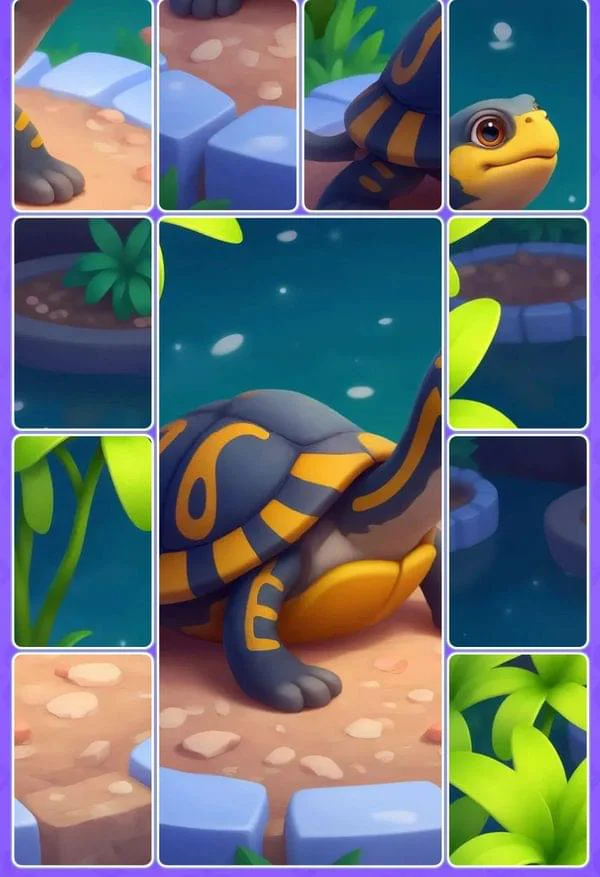
Every card is on the board. There is no empty space and no pile. A 5×5 picture is always 25 cards in 25 places.
A move is a swap. Drag a card onto another place and the two trade spots: the card you moved takes the new place, the card that was there goes back to where yours came from.
Correct neighbours join. When two cards that belong side by side touch, they lock together and become one piece. Pieces keep growing as you add to them, and a piece moves as a whole. When you drag it, every card it lands on is pushed back into the space it left.
You cannot lose. No timer, no move limit, no wrong answer that ends the level. The picture is done when the whole board is one piece.
That last point is what makes the format relaxing. A classic jigsaw can stall for ten minutes while you search for one piece. Here, the piece is always somewhere in front of you, and every correct swap makes the next one easier because there are fewer loose cards left.
Start small: what a 3×3 teaches you
Jigsolit begins with 3×3 boards, nine cards. They take seconds, but they show the whole idea: one obvious card, like the brightest part of an aurora, tells you where the sky is, and the rest sort themselves around it.

From 4×4 on, the same idea needs a plan.
A method for any board
1. Find your anchor
Before moving anything, look for the cards you can place with certainty. In order of usefulness:
- Corners. A corner card usually shows two edges of the scene: sky meeting a frame, a table corner, the edge of a wall.
- Unique details. A face, an eye, a sign, a single flower. There is only one card with that detail, and it has an obvious place.
- Strong lines. A horizon, a road, the rim of a well. These cross several cards and tell you which cards sit in the same row.
Move your best anchor card to its true place first. It is the only move that cannot be wrong.
2. Grow one piece, not five
Once the anchor is placed, add the cards that touch it. Each one you add joins the piece, and the piece becomes a bigger, surer reference. Resist the urge to start little groups all over the board. Two half-built pieces in the wrong places cost more swaps to fix than one piece that is already home.
3. Move the piece home early
If your piece formed somewhere in the middle of the board but belongs in a corner, move it there as soon as it is three or four cards big. Every card it pushes out of the way goes into the space it left, which is often closer to where that card belongs.
4. Fill rows, not holes
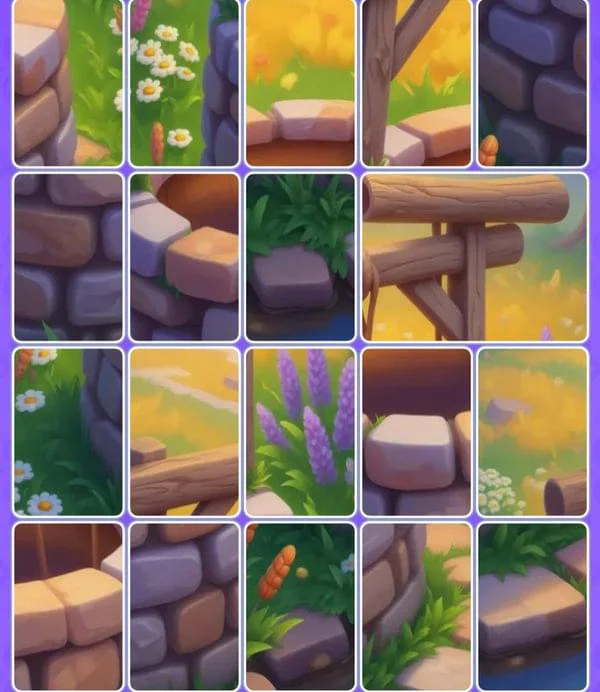
With one large piece in place, work outward row by row. Rows are easier than scattered holes because each new card has two neighbours to check against: the one beside it and the one above it.
5. Leave the plain areas for last
Sky, water, grass and plain walls look almost the same card by card. Leave them until the end, when there are only a few places left for them. Then sort by shade, light to dark, or by the direction of a gradient.
Why the swap matters
The one rule that trips up new players is that a move is a swap, not a slide. When you drop a card on an occupied place, the card that was there moves to where yours came from.
Use it. Before a swap, look at both cards. A great move puts both cards closer to home. A good move puts one card home and leaves the other no worse off. A bad move puts one card home and throws the other into the middle of an area you had nearly finished. Check both cards before you drag.
Hints and magnets
Both games have the same two boosters.
Hint shows one move: a hand drags one piece onto the piece it belongs beside. It is most useful in plain areas where you cannot tell cards apart.
Magnet takes the four pieces nearest the centre and sets them in their true places. On a fresh 6×6 board, that can be a quarter of the work.
The boosters are refilled with coins you earn from finished pictures. In Jigsaw Cards a picture usually takes under two minutes, and players use about one Hint for every ten pictures, so on most boards you will not need them at all.
Grid sizes at a glance
| Grid | Cards | Where you meet it |
|---|---|---|
| 3×3 | 9 | the first Jigsolit levels |
| 4×4 | 16 | the most common size in Jigsaw Cards |
| 5×5 | 25 | regular levels once you are past the start |
| 6×6 | 36 | hard and super hard levels, and the daily puzzles in Jigsaw Cards |
Which game to try
If you want drawn, colourful pictures, a long series of levels (over 2,400) and a town to restore as you go, play Jigsaw Cards. If you prefer real photographs and a quiet board, play Jigsolit. The rules are the same, so anything you learn in one works in the other.