How to clear any arrow puzzle without losing a heart
Arrow escape puzzles look simple: tap an arrow, it slides away. Then you meet a board with three hundred arrows packed into a flag, and the easy taps run out. This guide covers the habits that separate a clean clear from a run of red collisions. It is written for our three arrow games: Arrow Slide Puzzle, where every board hides a picture; Sort Arrows, where the board is the whole puzzle; and Sort Tiles, where the arrows sit on square tiles. The rules are the same in all three, so the same habits work everywhere.
The one rule that matters
An arrow can leave only if the straight line in front of its head is empty all the way to the edge of the board. Nothing else counts. The body of the arrow can bend around the whole board, past dozens of other arrows, and it will still follow its head out in one smooth slide.
This sounds obvious, but most wrong taps come from reading the body instead of the head. Train your eye to land on the arrowhead first, then run along the line it points to.
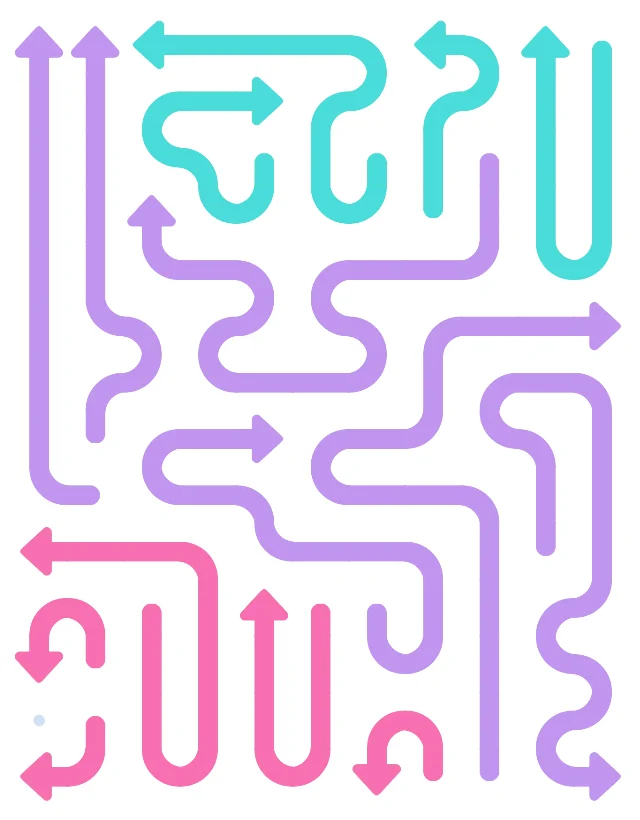
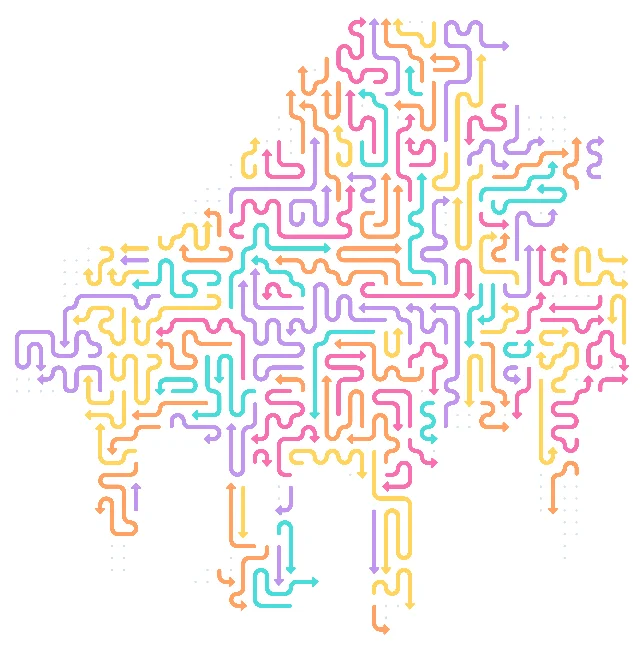
On this early board, the long purple arrow in the middle bends four times, but all that matters is the short line between its head and the right edge. If that line is empty, the whole arrow goes.
Habit 1: clear the rim
On every board, start with the arrows on the outside whose heads point outward. Nothing can stand between them and the edge, so they are always safe. Each one you remove also opens a lane for the arrows behind it, so the board gets easier with every rim arrow you take.
A good rhythm is to circle the board once, clearing every safe rim arrow, before you think about anything in the middle. On a big board this alone often removes a fifth of the arrows.
Habit 2: find the plug
Once the easy arrows are gone, most boards have one or two arrows that block everything else. We call them plugs: a long arrow lying across several lanes, or an arrow sitting right in front of a cluster of heads. Every arrow pointing into it is stuck until it leaves.
To find a plug, pick any stuck arrow and follow its line until you hit the first arrow in the way. Then do the same for that arrow. After two or three steps you usually reach an arrow whose own line is clear. That is the one to tap, and it often frees a whole chain at once.
Habit 3: never tap a face-off blind
Two arrows on the same line pointing at each other can never both go first. If you see a face-off, neither arrow is your next move. Something else is holding one of them, and the right move is whatever frees that side. Treat a face-off as a signpost, not a target.
Habit 4: use the free second tap
When you tap a blocked arrow, it slides up to whatever is in the way, turns red, bumps it and springs back. That costs a heart. But tapping the same arrow again costs nothing until the board has changed, and the bump shows you exactly which arrow is the obstacle.
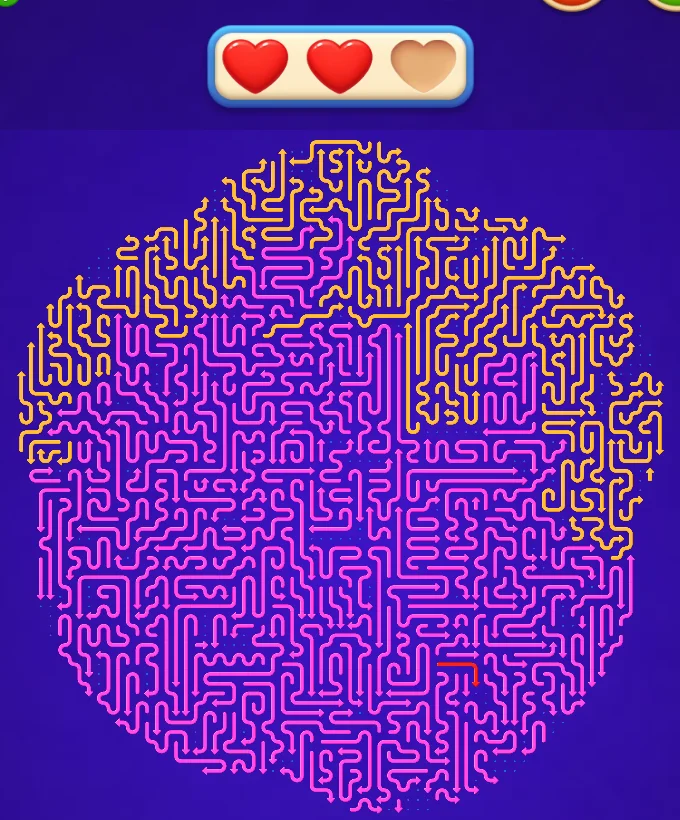
So if you have already paid for a collision, use it. Look at what the red arrow hit, then trace that arrow's line. You have just been shown the next link in the chain for free.
Habit 5: zoom before you guess
Big boards can be over a hundred cells wide, and the arrows get thin. At that size, a lost heart is usually a misread, not a bad idea. Pinch to zoom on a phone or use the zoom slider on desktop, and work one corner at a time. Clearing a corner completely before moving on also keeps you from losing track of which arrows you have already checked.
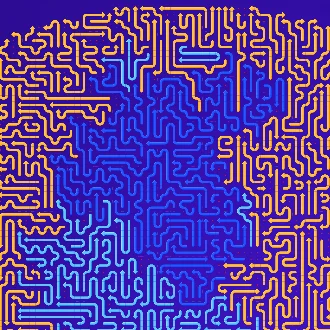
This close-up is from level 34 of Arrow Slide Puzzle, the level our players restart more than any other, with about 21 starts for every win. Zoomed in, it is a normal board. Zoomed out, every arrow is three pixels wide.
When to use a booster
All three games give you three boosters. Their names differ a little, but they do the same three jobs:

- Hint shows you one arrow or tile that is free to go. Use it when you have checked every rim arrow and every plug and still see nothing.
- Magnet (called the Magic Wand in Sort Arrows) sends several free pieces away at once. It does not solve anything you could not solve yourself, but it saves time on the long tail of a big board.
- Eraser (the Bomb in Sort Tiles) removes pieces even if they are blocked. That makes it the only booster that can get you out of a genuinely stuck spot, so it is worth saving for the dense middle of a Super Hard finale.
Players of Sort Arrows use the fewest hints of any of our games, about nine for every hundred wins. Sort Tiles players use the most, around 32. The difference is board size: Sort Tiles has the largest boards and the longest levels.
You can always win
Every board in these games can be cleared to the last arrow without a single collision. The arrow boards are checked for it before they ship, and Sort Tiles deals its arrows under a rule that guarantees it. If a level feels impossible, the way out is there; it is just hidden behind a plug. Clear the rim, follow one line at a time, and let collisions teach you rather than punish you.