How to play word solitaire, and how to stop running out of moves
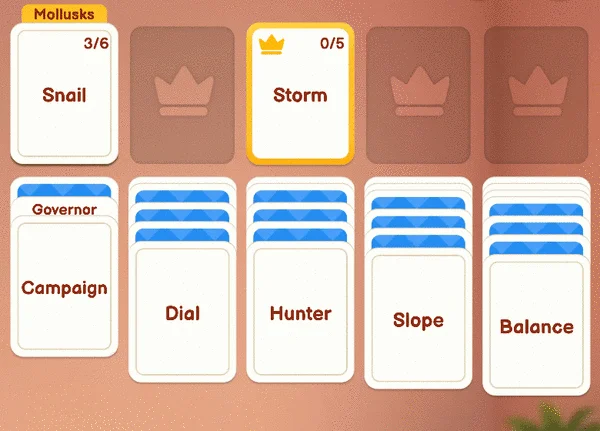
Word solitaire takes the layout everybody knows from classic patience, the columns, the face-down cards, the stock in the corner, and swaps one rule. Instead of building down by rank and alternating colour, you sort cards by meaning. A card that says Snail belongs with Octopus and Nautilus because they are all mollusks, not because of a number in the corner.
That one change makes the game feel very different. You are not counting, you are reading. This guide uses our own Solitaire Word Chains for the examples, but the habits apply to most games of this kind.
The rules in one minute
- Category cards carry a crown. Each one names a group: Seasons, Storm, Wallet, Mollusks.
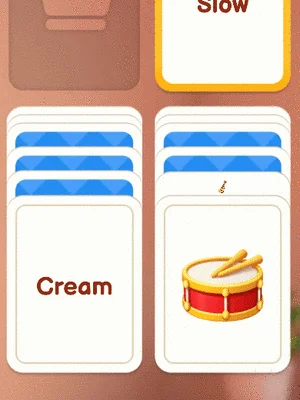
- Word cards belong to exactly one category in the level. Some categories use pictures instead of words, so a drum card might belong with other instruments.
- The top row is where categories live. Put a crown card into an empty slot to open it, then add its words. A counter such as 3/6 shows how many words are already in.
- The columns hold the deal. Only the top card of each column is face up. You can stack words of the same category on each other here and move matching runs together.
- The stock gives you a new card each time you tap it.
- Moves are limited. Every card move and every draw costs one. Clear the board before the counter reaches zero.
When a category has all its words, it clears from the board. Clear them all and the level is won.
Habit 1: open categories as soon as you can
A crown card buried in a column is the most expensive thing on the board. Every card on top of it is stuck until you dig it out, and the words for that category have nowhere to go except onto each other.
So when a crown card comes to the top of a column and you have an empty slot, move it up. It almost always pays back the move straight away, because the words you have been holding in the columns can now go home.
Habit 2: never fill the last empty slot blindly
The top row has a fixed number of slots, and a category stays there until it is complete. If every slot holds a category you cannot finish yet, and another crown card turns up, it has nowhere to go.
This is the most common way to lose a level that looked fine. Before you open a new category in your last free slot, ask whether you can see most of its words already. If not, wait. Opening the category you can finish now, then clearing it, gives you the slot back.
Habit 3: draw last, not first
A draw from the stock costs exactly as much as a move on the board, but tells you less. A move that turns over a face-down card in a column shows you a new card and clears space. A draw only shows you a new card.
Make a habit of scanning the columns before every draw. Can a word go onto its category? Can a run move to uncover a hidden card? If yes, do that first.
Habit 4: turn over hidden cards early
Every face-down card is a question you have not answered yet. The sooner you know what is under a column, the sooner you can plan around it. Given two moves of equal value, pick the one that reveals a card.
In Solitaire Word Chains this is also safe in a way it is not in classic solitaire. Since October 2026 the game makes sure that the card you turn over never leaves the level impossible to win. You still have to play well, but you will not lose to an unlucky hidden card.
Habit 5: undo instead of guessing
If a move turns out badly, take it back. Undo returns the card and refunds the move, so a slip costs nothing. It is a far better tool than the hint for learning a level, because you keep thinking for yourself.
Use the hint when you have genuinely run out of ideas. It shows one useful move with a pointing hand, which is often enough to see the pattern you missed.
Reading tricky categories
The puzzle in word solitaire is not just where cards go, but what a category means in this particular level. A few patterns come up again and again.
Words with two meanings. Current could be a stream of water, electricity, or "up to date". Lava and Sunlight can both be streams too. If a word fits nowhere, re-read every open category and ask which one it could belong to in a less obvious sense.
Close neighbours. Storm might hold Lightning, Thunder, Cyclone, Typhoon and Monsoon, while another category in the same level is about weather in general. When two categories overlap, look for the most specific fit.
Picture cards. Some levels use pictures instead of words. Name the picture in your head in two or three different ways ("drum", "music", "percussion", "toy") before deciding where it goes.
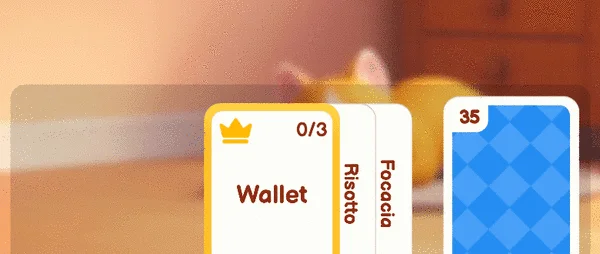
Short lists. A category with three words, such as Wallet with License, Money and Receipt, clears quickly. If you are short on slots, open the short categories first.
How hard does it get?
Early levels have four or five small categories and three columns. Later ones have a dozen or more categories across five or six columns. Before a level is released, a computer player plays its deal fifty times, and a deal is only kept if it never gets stuck. The move limit is set from that player's best game with a few moves to spare, so every level can be won within its limit, but on hard and super hard levels there is not much room for waste.
Across our players, the level that takes the most tries is a super hard level near 191, at about twelve attempts per win. If you are stuck on a level like that, the five habits above are where the spare moves come from.
A quick checklist
- Is there a crown card I can move to an empty slot?
- Can any face-up word go home to its category?
- Is there a move that turns over a hidden card?
- Am I about to fill my last empty slot with a category I cannot finish?
- Only then: draw from the stock.
Run through it before every draw and most levels stop feeling tight.