How to solve a Lambs Apart puzzle without guessing
Every puzzle in Lambs Apart has exactly one answer, and every one of them can be reached without a single guess. That is a promise about how the levels are made, but it is also a promise about you: whenever you feel stuck, there is a reason somewhere on the board that settles the next square. You only have to know what kind of reason to look for.
This guide walks through the ideas that crack almost every board, in the order the hint itself tries them, from the simplest to the deepest. All the pictures come from one real level: level 19, a 10×10 board that players retry more often than almost any other early level.
The rules, once more
A board of N×N squares is split into N colours, and it hides N lambs:
- one lamb in every row,
- one lamb in every column,
- one lamb in every colour,
- and no two lambs may touch, not even diagonally.
Double-tap places a lamb. A single tap or a swipe places a cross, which means "no lamb here". Crosses are free; only a lamb on a wrong square costs a heart. So the whole skill of the game is placing crosses with confidence until the lambs have nowhere else to go.
When you place a lamb, the game crosses off its row, its column and the eight squares around it for you. Keep that in mind: every lamb you find does a lot of work for free.
Idea 1: a colour with one square left
Here is level 19 before a single move. Look along the bottom row: one square there is a colour all of its own, a colour made of a single square. A colour needs one lamb, it has one square, so the lamb is there.
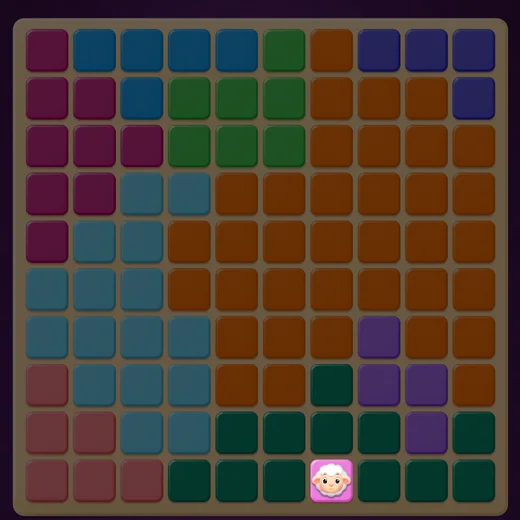
This is the first thing to look for on any fresh board, and it keeps coming back all the way through. As you cross squares out, colours shrink, and sooner or later one of them is down to its last square.
The same idea works for rows and columns. If a row has only one open square left, the row's lamb lives there.
Idea 2: a colour stuck in one row
Once the first lamb is placed, its row and column are crossed out. Now look at the dark green colour in the bottom right corner. Its squares in the bottom row are gone, so everything it has left sits in the row just above. Dark green must put its lamb somewhere in that row.
But a row only has one lamb. If the dark green lamb is in that row, no other colour can use it. Every square of that row that isn't dark green can be crossed out.
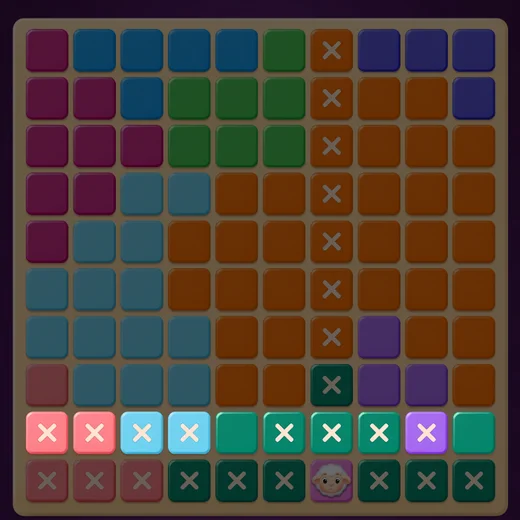
This idea, a colour trapped in a single row or column, is the workhorse of the game. On medium boards most of your crosses will come from it. It also works the other way round. If every open square of a row belongs to one colour, that colour's lamb is in the row, and the colour's squares in other rows can go.
Idea 3: a lamb that would block a colour
A few moves later, look at the small indigo colour in the top right corner. It has three open squares left, all huddled together. Now imagine a lamb on the orange square right next to them.
That lamb would touch all three indigo squares, and lambs can't touch. Indigo would have nowhere left for its lamb, which breaks the rules. So the orange square can't hold a lamb: cross it out.
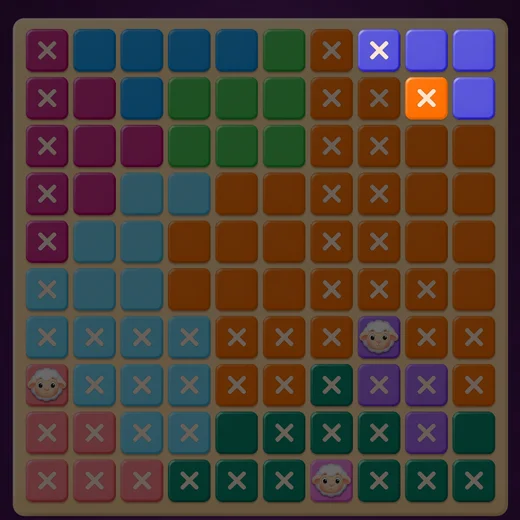
This is not guessing. You are not placing the lamb and hoping. You picture it for a moment, see that it leaves a colour (or a row, or a column) with nowhere to go, and rule the square out. Small colours tucked into corners are where this idea pays off most.
Idea 4: two colours sharing two rows
Now look at the top two rows. The bright blue colour has open squares only in those two rows, and so does the indigo colour. Two colours, both needing a lamb, both limited to the same two rows. And those two rows have room for exactly two lambs.
So the top two rows belong to blue and indigo between them, and no other colour can have its lamb there. The green and magenta squares in those rows can all be crossed out.
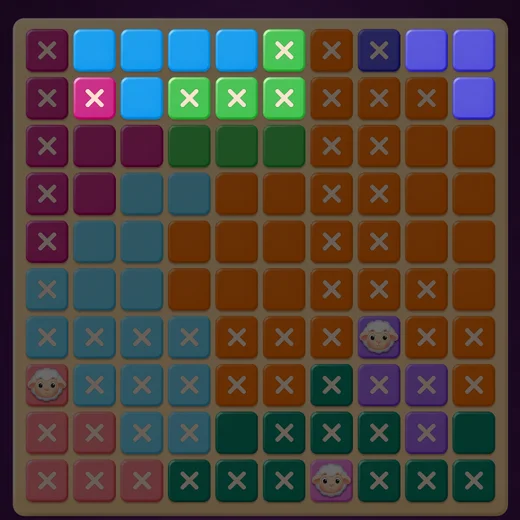
The same counting works with three colours in three rows, or four in four columns. It is the idea that cracks the bigger boards, because the trapped colours are often far apart and easy to miss. A quick way to spot it is to count, for each pair of neighbouring rows, how many colours live only inside them.
The board falls into place
After those crosses, things move quickly. The second row from the top now has a single open square, so its lamb goes there (idea 1 again, for a row this time). Placing it crosses out its neighbours, which shrinks two more colours, and the rest of the lambs follow one after another.
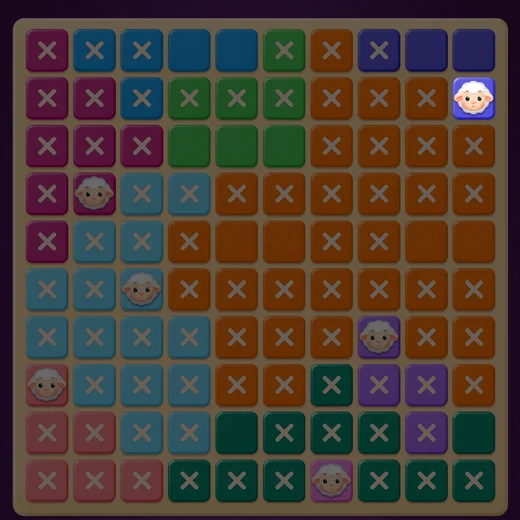
This is the rhythm of most levels: a few easy finds, a stretch where you need one of the deeper ideas, and then a cascade.
One more shortcut: the 2×2 square
Since lambs can't touch, any 2×2 block of squares can hold at most one lamb. That makes small colours easy to read. If a colour's open squares all fit inside one 2×2 block, look at the squares just outside it: any square that touches every one of the colour's open squares must be empty, because a lamb there would leave the colour nowhere to go. With a colour of two or three squares in a line, that often rules out three or four squares at once, long before you need the heavier ideas.
What about the really hard boards?
The hardest levels, usually the 12×12 finales of each chapter, ask for wider versions of idea 4 (three or four colours trapped across the same rows or columns) and, rarely, a deeper "what if": imagine a lamb on a square, follow the simple ideas from there in your head, and find that some colour, row or column runs out of room. That proves the square is empty. It takes patience, but it is still reasoning rather than guessing, and the board will never ask you to gamble a heart on it.
Let the hint teach you
The light-bulb hint uses exactly these ideas, in this order. It always looks for the simplest one that works, then names it in a sentence, such as "This color has to go in this row, so nothing else can", and highlights the squares it settles. If you use it when you are stuck and read the sentence before you press Apply, you will start spotting the same pattern on your own within a few levels.
A good routine for any board:
- Find single-square colours, rows and columns.
- Look for colours trapped in one row or one column.
- Check the small colours in corners: would a lamb next to them leave them nowhere to go?
- Count colours against pairs of rows and pairs of columns.
- Only then reach for the hint.
There is no clock, so take your time. Every puzzle in the game has an answer you can see, if you look in the right place.