How we make and test the levels in our sorting games
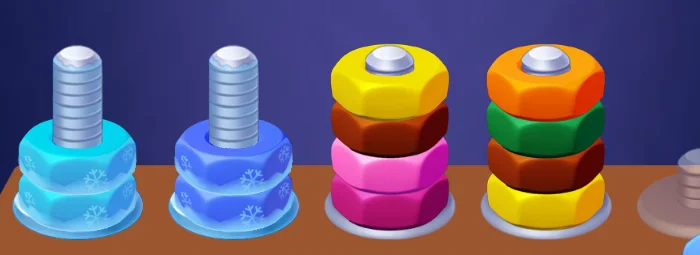
Magic Bottles and SortWorks look like two different games. In one you pour colored liquid between glass bottles on a beach bar shelf; in the other you spin colored nuts between bolts in a workshop. Underneath, they are the same puzzle, and they share the same 300 levels. This article explains, from the player's side, how those levels are put together, what has to be true before one reaches you, and what happens after millions of people have played it.
A level is drawn by hand
Each level is laid out by a level designer in our editor: how many containers there are, how many layers of each color go where, which containers start empty, and which special pieces appear. Nothing is generated on the fly while you play, so the level you see on level 48 is the level every other player sees on level 48.
What does change every time is the paint. A level stores only the pattern ("these three layers are the same color, that one is different"), and the game picks the actual colors from a palette each time you open it. If you lose a level and try again, the colors will probably be different. The puzzle is identical, but your eyes get a fresh look at it, which makes a retry feel less like a repeat.
The first levels teach one thing at a time
The opening levels are tiny on purpose.
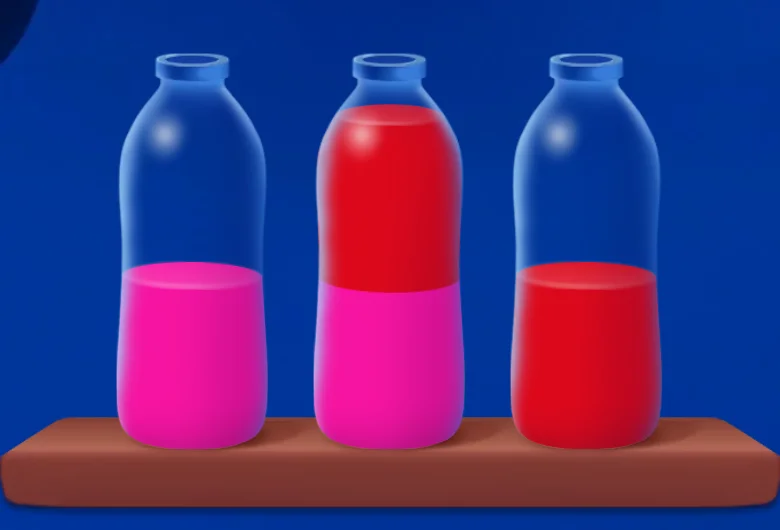
Level 2, above, has three bottles and two colors. There is nothing to plan; the level exists to show that liquid only pours onto the same color. Over the next few levels the shelves fill up, and from level 7 the first hidden layers appear: question marks that only show their color when they reach the top.
New ideas then arrive slowly, each with a short tutorial the first time you meet it:
- level 20: covered containers, which open when you finish the color shown on the cover;
- level 60: locked containers, which accept pieces but give nothing back until they are full of one color;
- level 110: frozen containers, which open when a container right next to them is completed.
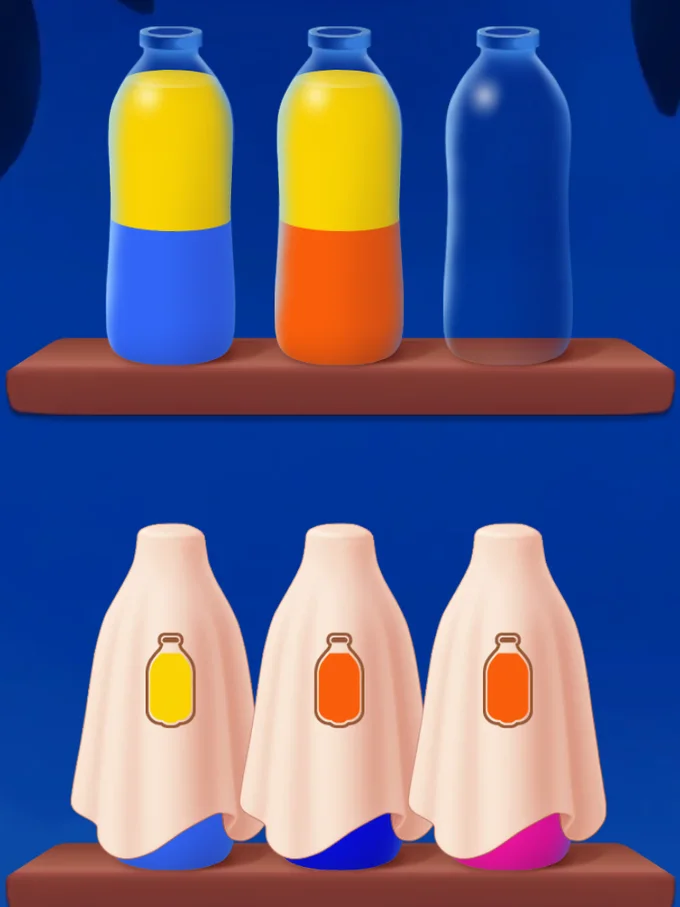
Spacing them out matters. A new rule is the most confusing thing in a puzzle game, so each one gets dozens of levels to settle in before the next one arrives. Covered bottles on level 20 have forty levels of company before the first locked bottle shows up.
Difficulty is a wave, not a ramp
If every level were harder than the one before, the game would become a wall. Instead, difficulty rises and falls. Most levels are comfortable, and then about one level in fifteen is a Hard level, announced with a badge before it starts.
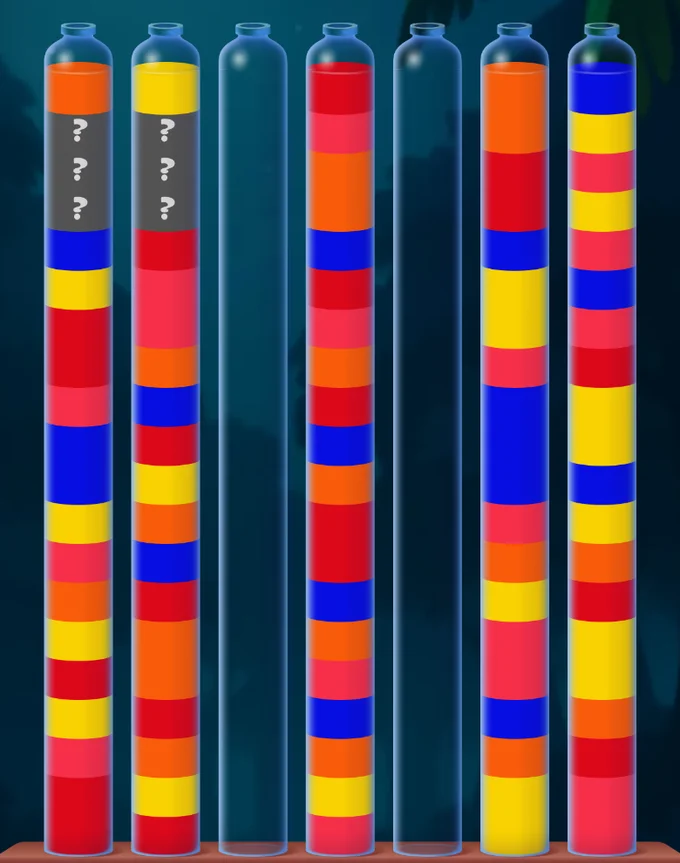
Hard levels change the shape of the problem rather than just adding more of the same. The usual containers hold four pieces; on Hard levels they are tall tubes holding twelve or twenty. You have to think in long runs and plan several moves ahead. The level after a Hard one always goes back to normal containers, so you get a breather.
We deliberately do not use the other common ways of making puzzles harder. There is no timer, no move limit and no score for speed. Difficulty comes only from the arrangement of the pieces, so you can always stop and think.
Two checks before release
Before a level ships, a small program reads it and refuses anything that is broken. It checks, among other things, that:
- every color has exactly enough pieces to fill one container, no more and no less;
- every covered container can actually be uncovered, because the color that opens it can be collected somewhere else on the board;
- no locked container starts with a mix of colors, since it could never get rid of the wrong ones;
- every hidden piece has a real color behind its question mark.
We run the same check over the whole set after levels are edited, and every edit gives the level a new version number, so we can compare how the old and the new version play.
The second check is a person. Every level is played and solved by our team before it goes into the game. Levels that feel unfair, or that play out the same way as their neighbours, are cut or reworked, so the 300 in the game are a hand-picked set, not everything the editor ever produced.
Then the players take over
The real test of a level is how people play it. For every level we look at how many attempts it takes, on average, to win it once. Across both games the typical level is won in about 1.35 attempts. A handful sit far above that: over the last two months, levels 134 and 270 each needed six or seven tries per win, and level 48 about five.
A level that stands far above its neighbours is not automatically a bad level. Some players enjoy a wall now and then, and Hard levels are supposed to stand out. But when a regular level needs several times the usual number of tries, we take another look at it. Usually a small change is enough: one fewer hidden layer, one more empty container, or a different starting position for one color. Since the summer of 2026 we have eased more than thirty levels this way, among them levels 10, 34, 38, 39, 48, 50, 90, 121, 150, 155, 179, 204, 243 and 279, often in batches that go out with a regular update.
Messages to our support team are the other half of the picture. They tell us where players are confused rather than where they are stuck, and the topic we hear about most by far is ice: what it is, why a bottle is frozen, and what thaws it. Frozen containers have their own vibration feedback on phones, and when ice is what blocks your last moves, the window that opens says "Ice Blocked" and offers the hammer directly. This page and the answers on each game page are partly written from those questions.
What happens after level 300
There are 300 hand-made levels. When you finish the last one, the game does not end; it keeps picking levels from the whole set and painting them in new colors. Some players have gone well past level 1,000 this way. If a level past 300 feels familiar, that is why, and if you already solved it once, you can solve it again.
In short
A sorting level in our games is drawn by hand, checked by a program, played and solved by our team before release, introduced at a pace that gives each new idea time to settle, and then watched closely once it is live. When the numbers say a level is much harder than it should be, it gets eased. If you meet one that seems impossible, tell us through the Support button in the settings: that is one of the ways a level ends up on the list.