How to solve color sort puzzles - a strategy guide for nuts and bottles
Color sorting puzzles look like a game of patience: pour, pour, pour until it works out. Play a few hundred levels, though, and you notice that the same small handful of ideas wins almost every board. This guide collects them, using positions from our two sorting games, Magic Bottles (liquids in bottles) and SortWorks (nuts on bolts). The two games share the same 300 levels, so everything below works in both; only the pieces look different.
The one rule that matters
Every sorting puzzle runs on a single rule: you may only place a color on top of the same color, or into an empty container. Everything else, every trick in this guide, follows from that.
It means that the top of each container is the only part that matters right now, and it means that an empty container is special. It is the only place that accepts any color. Most dead ends happen because the player has no empty container left and every top color is different.
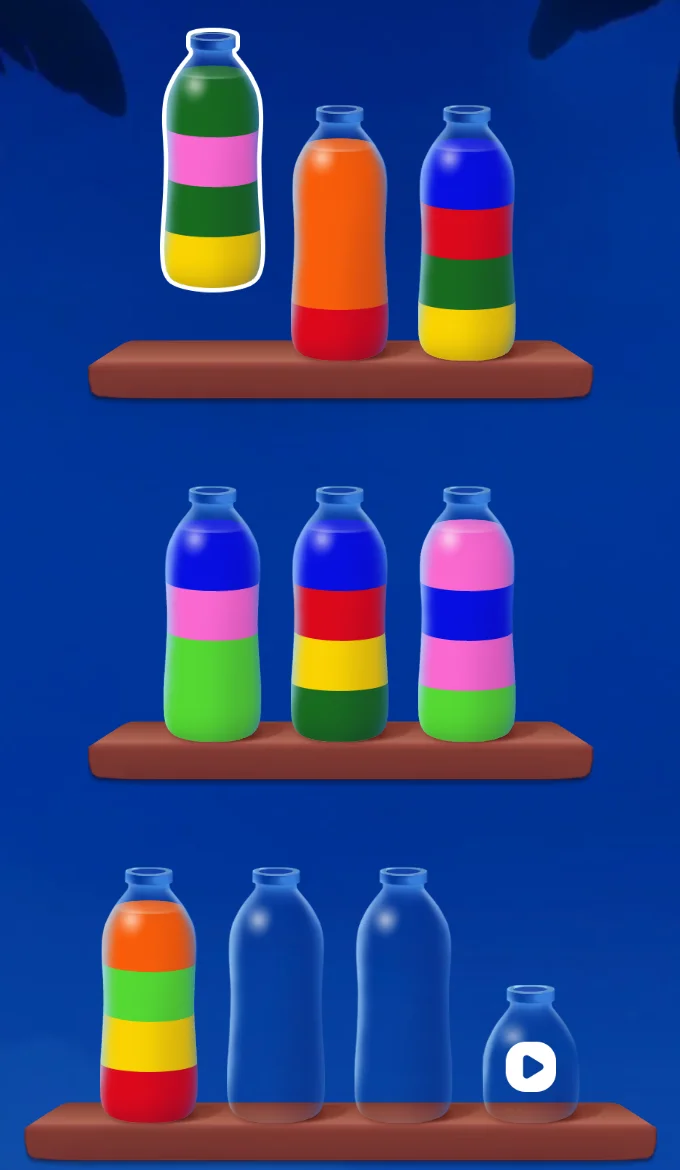
Look at the board above. The bottle lifted in the top left has dark green on top, and no other bottle shows dark green, so the only legal pour is into one of the two empty bottles at the bottom. That pour is not wrong, but it spends a resource. Now look at the tops again: three bottles have blue on top. Pouring blue onto blue costs nothing, gathers a color, and keeps both empty bottles free. That is the kind of move to look for first.
1. Count your empty containers before every move
Treat empties as your budget. A level with two empty bottles gives you a lot of freedom; a level with none leaves you only with "same color on same color" moves.
- A pour that empties a container is almost always good.
- A pour that fills an empty container with a single layer is a cost. Make it only if it unlocks something specific.
- When you are down to one empty container, slow down. That is when a careless pour ends the level.
2. Move whole runs, not single pieces
When two or three layers of the same color sit together at the top, they all move at once. One move that carries three layers is worth three moves later. The opposite habit, pouring part of a run so that one color ends up split across two containers, is the most common way to make a level harder than it is.
If the target only has room for part of a run, the rest stays behind. Sometimes that is exactly what you want; usually it is not.
3. Finish colors, one at a time
A container filled to the top with one color seals itself. It cannot be touched again, and it no longer takes up any of your thinking. Pick the color that is already closest to complete, finish it, and move on to the next. Spreading your progress across five colors at once feels productive but leaves you with five half-built containers and no room.
There is a second reason to finish colors early: in both games, finishing a container can unlock special pieces next to it, as we will see with ice below.
4. Uncover the question marks early
From level 7 on, some layers are hidden under question marks and show their color only when they reach the top.
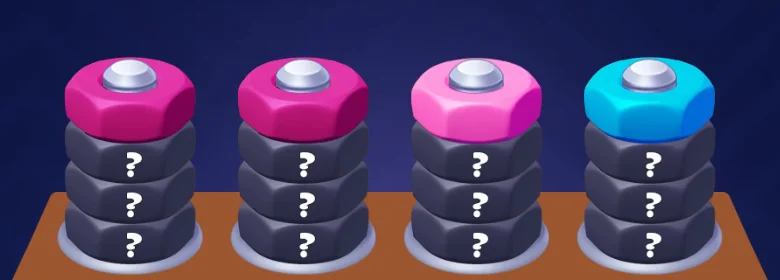
A hidden layer is information you do not have yet, and most "suddenly stuck" moments come from a surprise color appearing when there is nowhere left to put it. So uncover hidden layers while you still have empty space, not at the end. On a board like the one above, where almost everything is hidden, spend your first moves revealing, not sorting.
5. Read the special containers
Later levels bring containers with their own rules. You do not have to fear any of them once you know what opens them.
- Covered containers (from level 20) are hidden under a cloth with a small colored icon. The cloth lifts when you finish that color somewhere else.
- Locked containers (from level 60) accept pieces but never give them back until they are full of one color. Pick which color goes there and send only that color.
- Frozen containers (from level 110) are sealed in ice. Nothing goes in or out until a container right next to them is completed.
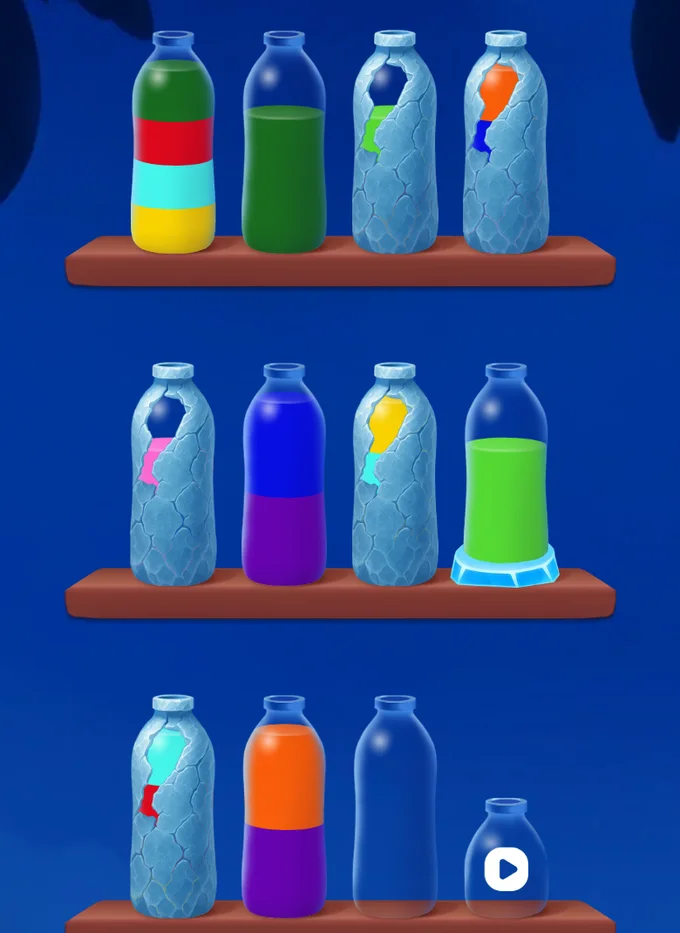
Frozen containers are where most players ask for help. The trick is to stop looking at the ice and look at its neighbours. In the board above, five bottles are frozen, and the green bottle standing on an icy base on the middle shelf is a locked one: it will only ever take more green. The frozen bottles sit between ordinary ones. Completing one of those ordinary bottles melts the ice beside it and releases the colors inside. If a color you need is trapped in the ice, that is not a broken level: finish a neighbour using the colors you can reach, and the ice gives the trapped color back. When ice is the only thing between you and the end, the game also offers a hammer that breaks every block of ice at once.
6. Plan further ahead on tall tubes
About one level in fifteen is a Hard level, and Hard levels replace the normal four-layer containers with tall ones that hold twelve or twenty.
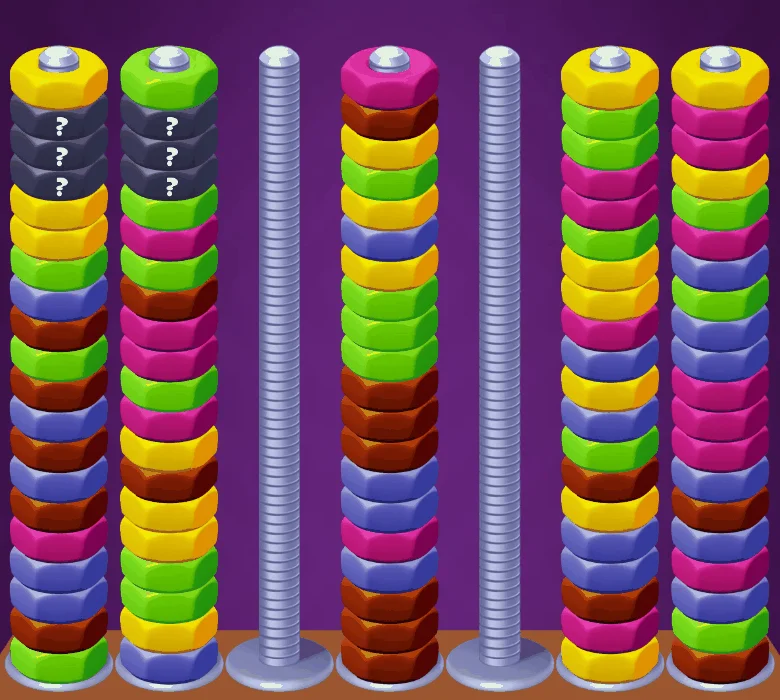
On tall tubes the usual advice still holds, with two changes:
- Empty tubes are worth even more. An empty tube can absorb a long run of one color, which can be a dozen moves of progress at once.
- Work top-down. You cannot see the whole tube at a glance, so focus on the top five or six layers of each tube, find which color appears most often near the top, and make that your first target.
7. Use Undo, not restarts
Both games give you an Undo booster (the blue curved arrow). One bad pour almost never ruins a level; undoing it costs far less than restarting and repeating twenty correct moves. The other booster, Swap (orange and purple arrows), exchanges the top two pieces of a container you choose. It is best saved for the moment when the color you need is exactly one layer down.
A quick checklist
Before each move, run through these four questions:
- How many empty containers do I have, and does this move spend one?
- Am I moving a whole run of one color?
- Is there a hidden layer I should uncover while I still have room?
- Which container, if finished, would open a cover or melt some ice?
None of this takes long once it becomes a habit, and it turns most "impossible" levels into slow but steady ones. Of the more than 140 million levels players have won in Magic Bottles and SortWorks since November 2025, the typical one took less than one and a half attempts. With a plan, yours can too.